
Pedestrian Gate Access Control Options Explained
Pedestrian Gate Access Control Options Explained
When a pedestrian gate goes into a commercial project, the gate itself is only part of the system. The access control equipment attached to it determines who gets through, how the entry event is recorded, and how easily credentials can be managed over time. Choosing the right option depends on the site, the user population, and how the property owner expects to manage access day to day.
For general contractors specifying or installing pedestrian gate systems, understanding the common access control options — and what distinguishes them — is essential to building something that works reliably after the project is complete. More background on pedestrian gate hardware itself is available at DNG's pedestrian gate resource.
How Pedestrian Gate Access Control Differs from Vehicle Gate Control
Pedestrian gates present different challenges than vehicle gates. They are used more frequently, often by a more varied user population, and the interaction happens on foot at close range. That affects which credential types are practical and what hardware holds up over time.
A pedestrian gate reader or keypad needs to be at a comfortable standing height, easy to operate without fumbling, and durable enough to handle repeated daily contact. Vehicle gates prioritize methods that work without the driver leaving the vehicle — long-range readers, remote transmitters, or license plate recognition. On a pedestrian gate, the interaction is deliberate and close, which opens up options that wouldn't work at a vehicle entrance.
PIN Keypads
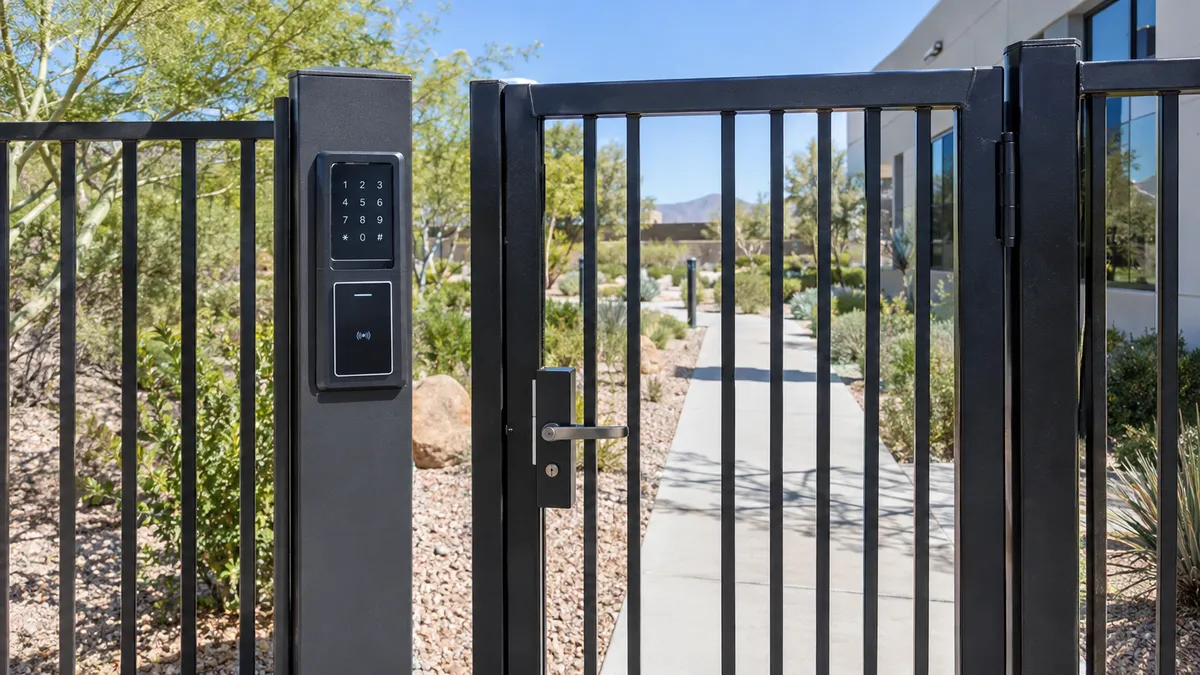
A keypad is the most straightforward credential method. Users enter a numeric code to trigger gate release. Standalone keypads can operate with minimal infrastructure, making them a practical option on projects where networking is limited or where the user population is small.
The limitation with keypads becomes apparent on larger sites. A shared PIN offers no record of who entered at a given time. Individual PIN assignment addresses that, but administering hundreds of unique codes creates management burden. Shared codes also carry a risk: a code distributed to a contractor who has since left the project continues to work unless it's explicitly changed.
Keypads are well suited to secondary pedestrian access points, low-traffic entrances, or sites where temporary code access is a deliberate part of the workflow rather than a workaround.
Card Readers and Key Fobs
Card readers and fob readers use RFID technology to grant access. Each user carries a proximity card or key fob assigned to them individually. When presented to the reader, the credential is checked against the system's authorized list, and the gate releases if there's a match.
Individual credentials provide meaningful advantages over shared PINs. A lost fob or a card belonging to a former employee can be deactivated without changing anything for anyone else. The system can also log each access event by user, giving the property manager a searchable record of who entered and when.
Fob and card systems do carry some operational overhead. Each credential must be enrolled, tracked, and removed when no longer needed. On large properties with significant staff turnover, that administration can be substantial. Physical credentials can also be lost, forgotten, or — less commonly — cloned.
Telephone Entry and Intercom Systems
Telephone entry systems are designed for visitor access rather than routine authorized-user entry. A visitor at the pedestrian gate uses the panel to call a resident, tenant, or management office. Once the party on the other end verifies the visitor's identity, they press a key to release the gate remotely.
Audio-only telephone entry systems have been standard at multi-tenant properties for decades. Video intercom systems add a camera at the entry panel so the person granting access can see the visitor before releasing the gate. That visual confirmation provides an additional layer of screening that audio alone doesn't offer.
For visitor-heavy environments — residential communities, office complexes, or properties that receive frequent deliveries — a telephone entry or intercom system addresses a gap that credential-based systems don't. Authorized users get in with their card or fob; visitors use the intercom. The two methods can coexist on the same gate.
Mobile Credentials and App-Based Access
Newer access control systems support mobile credentials, where an authorized user's smartphone acts as the credential. The phone communicates with the reader via Bluetooth or NFC at close range. No physical card or fob is required.
Mobile credentials offer some practical advantages. Issuing a new credential is a software operation — no physical card needs to be produced and handed to someone. Revoking a credential can happen remotely and takes effect immediately. The system can also log access by user with the same granularity as a card system.
The tradeoff is dependency on the user's phone. Dead batteries, software issues, or users who don't keep the app updated can create access problems. For commercial properties serving employees or controlled user groups, mobile credentials work well. For sites where the user population is older, less tech-comfortable, or highly variable, a physical credential option is often more reliable in practice.
Wireless Remote Transmitters
Remote transmitters — often called key fob remotes or clickers — allow gate release with a button press from a short distance. They are common at residential and light commercial pedestrian gates where the user population is small and consistent.
Remotes are convenient but limited in administrative capability. They don't log individual access events, and replacing or deactivating a lost remote requires reprogramming depending on the system. For sites with larger or changing user populations, remotes typically work better as a supplemental credential than as the primary access method.
Choosing the Right Option for the Project
No single access control method fits every pedestrian gate. The practical choice depends on the number of users, how often credentials will need to be added or removed, whether visitor access needs to be accommodated, and what infrastructure — power, network connectivity — is available at the gate location.
Smaller sites with a stable user group can often be well served by a keypad or fob system. Larger commercial properties with frequent staff changes, a mix of authorized users and visitors, or a need for detailed access records typically benefit from a card or mobile credential system paired with a telephone entry or intercom solution. The two layers — credential for known users, intercom for visitors — complement each other.
It's also worth confirming compatibility between the access control equipment and the gate operator before finalizing a specification. The access control system sends a signal to release the gate operator; the operator and the access control hardware need to be wired to communicate correctly. That interface point is where installation problems most commonly occur when equipment is selected independently.
What This Means for Gate Projects in Practice
Pedestrian gate access control is a decision with long-term consequences for the property. The right option for a construction handoff isn't necessarily the easiest to install — it's the one that the property manager can actually administer and that holds up as the user population changes over time.
Understanding the strengths and limitations of each credential type makes it possible to specify a system that serves the property well beyond the initial installation. DNG Automatic Gates works with commercial and residential properties throughout the Las Vegas Valley on pedestrian gate access control installations, including telephone entry systems, card readers, and app-based solutions paired with swing and slide gate operators.