Residential vs. Commercial Automatic Gates: What Changes?
Residential vs. Commercial Automatic Gates: What Changes?
Automatic gates look similar at a glance. Both open and close. Both use motors and control systems. But the similarity ends there. When a property manager asks whether a residential-grade gate system will work for a commercial property, the honest answer is: not reliably -- and the reasons go well beyond what any spec sheet shows on the surface.
Understanding what actually separates these two categories helps anyone responsible for gate-controlled access make better decisions about installation, replacement, and long-term maintenance.
The Duty Cycle Difference Is the Starting Point
Duty cycle describes how many times a gate operator is designed to open and close within a given day without overheating or degrading mechanically. It is the single most consequential difference between residential and commercial systems.
Residential gate operators are typically engineered for around 10 to 20 cycles per day -- sufficient for a single-family home or a small multi-unit property with minimal traffic. Commercial operators, by contrast, are designed to handle hundreds of cycles daily, and heavy-duty industrial units can sustain continuous operation around the clock.
This distinction matters because exceeding a residential operator's rated duty cycle is not just a performance issue -- it causes accelerated wear, thermal shutdown events, and premature mechanical failure. A gate that logs dozens of daily openings at a busy commercial entrance will overwhelm a residential-grade motor within a relatively short time, regardless of how well the equipment is otherwise maintained.
How Gate Size and Weight Drive Equipment Selection
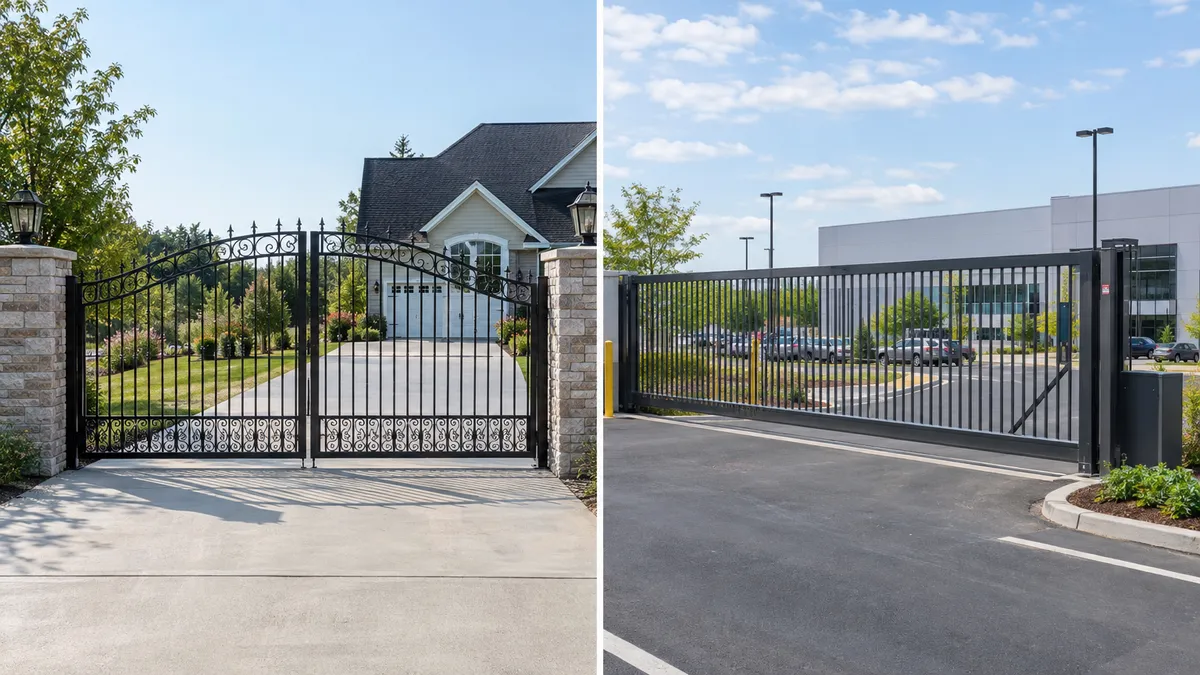
Residential gates typically span a private driveway and are built with lighter materials. The motor and hardware required to operate them reflect that scale.
Commercial properties often require gates wide enough to accommodate delivery vehicles, service trucks, and heavy equipment. Larger openings require heavier gate panels, and heavier panels demand operators with substantially more torque, stronger drive mechanisms, and more robust mounting hardware.
Commercial operators commonly feature metal gearing -- steel or bronze -- rather than the nylon or composite gears found in lighter residential systems. Steel enclosures replace plastic housings. Internal components are built to withstand greater shock loads and sustained mechanical stress over years of high-frequency use.
Access Control Requirements Are Fundamentally Different
A homeowner typically manages gate access with a handful of remotes and perhaps a keypad. The credential set is small and rarely changes.
A commercial property operates under a different model entirely. Multiple user groups need access -- tenants, employees, service vendors, emergency vehicles, and sometimes members of the public -- and they need it managed consistently across different shifts, days, and access points. Commercial gate systems are designed to integrate with card readers, telephone entry systems, key fobs, and increasingly with cloud-based platforms that provide detailed entry and exit logs.
For property managers, that audit capability has practical value beyond security. It supports incident documentation, helps track contractor access, and creates accountability records that a basic residential keypad simply cannot produce.
Understanding automatic gates at this level means recognizing that the access control layer is often as important as the gate hardware itself.
Safety Standards Differ Between Application Classes
UL 325 is the primary safety standard governing gate operators in the United States. Under this standard, operators are classified by their intended application, with Class I designating residential use and higher classifications covering commercial and industrial environments.
The distinctions are not arbitrary. Commercial installations involve more vehicles, more users, and more operational variables than residential gates. As a result, commercial operators must meet more stringent entrapment protection requirements -- often including multiple independent sensor systems, adjustable force settings, and comprehensive warning devices. Residential operators typically require only basic entrapment protection sufficient for the lower-risk environment they are designed for.
Installing an operator rated for residential use in a commercial environment may not satisfy applicable safety or code requirements, depending on the jurisdiction and specific installation conditions.
Operating Speed and Traffic Flow
At a private residence, a gate that takes a few extra seconds to open is rarely consequential. At a commercial property, slow gate operation during peak arrival and departure periods creates vehicle queuing, access frustration, and potential safety hazards in the approach lane.
Commercial gate operators are designed with faster cycle times in mind. Barrier arm systems, common in parking facilities and high-traffic commercial entrances, are purpose-built for rapid repetitive cycling precisely because their function depends on throughput. Sliding gate operators at commercial facilities similarly run at higher speeds than their residential counterparts, and their control systems allow adjustment of speed profiles for different operating conditions.
Power Supply Considerations
Most residential gate operators run on standard 120V AC power, with battery backup sufficient for a limited number of cycles during an outage. Solar options are also common for remote residential locations.
Commercial operators often require 240V supply, and some heavy industrial systems use three-phase power. The power infrastructure at a commercial gate location -- conduit routing, panel capacity, backup power continuity -- is a more significant planning consideration than it typically is in a residential installation.
Where the Two Categories Can Overlap
The line between residential and commercial equipment is not always sharp. Multi-family properties with moderate traffic -- larger apartment complexes, HOA-controlled communities -- may fall between the two categories, and operators rated for intermediate duty cycles exist specifically for these applications.
A small professional office with a handful of daily users may not need the same operator as a busy logistics facility. The relevant factor is not the label commercial or residential but the actual daily cycle demand, the gate's physical weight and dimensions, the access credential complexity, and the safety compliance requirements for that specific installation type.
Choosing the Right Gate System for a Commercial Property
When a property manager is evaluating an automatic gate installation or replacement, the relevant questions are practical ones: How many vehicles use the gate daily? What access credential complexity is required? What is the gate's weight and span? What are the backup power requirements if the primary supply fails?
Matching equipment to those actual operating conditions -- rather than selecting based on price tier alone -- is what determines whether a gate system performs reliably for its expected service life or generates recurring maintenance costs and downtime.
DNG Automatic Gates serves commercial and residential properties across the Las Vegas Valley, and their established presence in the Southern Nevada market reflects more than a decade of working with both property types. For property managers navigating gate system decisions, the practical framework is straightforward: understand what your property actually requires before specifying the equipment that will run it.