Where Barrier Arms Work Best in Commercial Parking Lots
Where Barrier Arms Work Best in Commercial Parking Lots
In commercial parking, the right access control equipment isn't always the most robust. For a large number of sites, a full-panel gate is heavier hardware than the job actually requires. Barrier arms solve a different problem — one that plays out dozens or hundreds of times a day at busy lots, garages, and managed entrances. Understanding exactly where they perform best helps contractors specify the right system from the start, rather than retrofit after the fact.
What a Barrier Arm Is Designed to Do
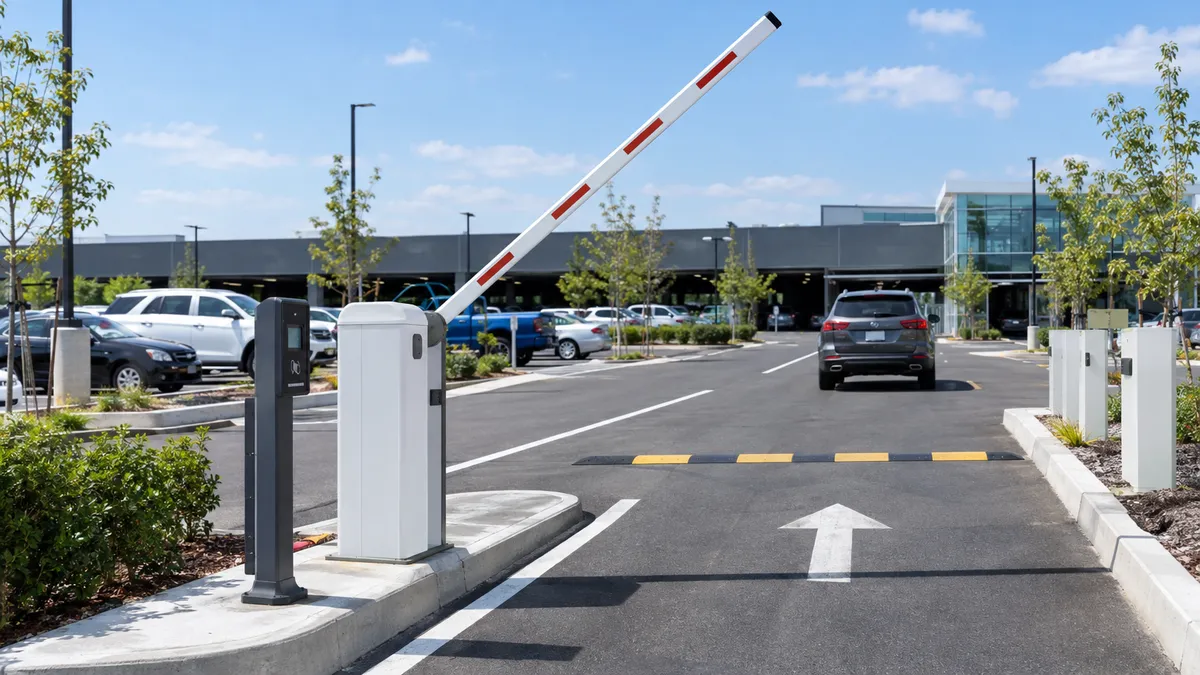
A barrier arm is a motorized access control device that raises and lowers a horizontal boom to manage vehicle entry and exit one vehicle at a time. The core job is traffic metering: admitting authorized vehicles in a controlled, orderly sequence while creating a clear signal to stop for everyone else.
That single-vehicle-per-cycle rhythm is the defining characteristic. The arm lifts, one car passes, and the arm returns. On a commercial site with steady vehicle flow, this cycle repeats hundreds or thousands of times daily. Because the arm only pivots upward rather than swinging or sliding horizontally, it occupies a minimal footprint at the lane — an important factor in tight urban or structured parking environments.
High-Volume Parking Lots and Paid Parking Facilities
Barrier arms are the default choice for commercial surface lots and paid parking facilities precisely because they handle volume without creating congestion. A commercial arm can clear a lane in two to four seconds, far faster than a sliding or swing gate that may take ten to twenty seconds to open fully. At an entrance receiving steady traffic during morning and evening peaks, that difference in cycle time compounds quickly.
Paid parking lots pair naturally with barrier arms because the equipment integrates directly with ticket dispensers, pay-on-foot stations, and pay-on-exit kiosks. The arm holds until a ticket is taken or a payment credential is validated, then lifts. On exit, the arm releases after fee payment is confirmed. This sequence is the operational foundation of most managed parking facilities, from downtown commercial lots to event venue parking.
Parking Garages, Especially Those with Low Overhead Clearance
Structured parking garages present a site condition that barrier arms handle particularly well: limited overhead clearance. A standard straight-arm barrier rises vertically, but articulating, or folding, arms use a hinged design that allows the boom to bend upward at a joint rather than rising to full vertical height. This makes articulating arms the correct choice for covered entries and underground garages where ceiling height would prevent a straight arm from clearing.
High-speed barrier arm operators are available for garages with very high cycle volumes, such as hospital parking structures, airport economy lots, and transit facility garages. These operators are rated for significantly more cycles per hour than standard commercial units and are built to sustain continuous-duty operation without overheating or premature wear.
Office Buildings, Campuses, and Employee Lots
Commercial office buildings and multi-tenant campuses are among the most common applications for barrier arms, particularly at employee and tenant parking entrances. These sites have predictable traffic windows — arrivals in the morning and departures in the evening — and need a system that moves authorized users through without delay.
Card readers, key fobs, RFID proximity readers, and license plate recognition cameras all integrate readily with barrier arm operators. On a campus with multiple entrances serving different user groups, separate arms at each lane allow access to be managed by credential type: employee badges at one entry, visitor processing at another. This lane-based structure is more practical than routing all traffic through a single full-gate opening.
Loading Docks and Controlled Service Entries
Loading dock and service entrance environments often need basic vehicle metering rather than perimeter closure. A barrier arm at a loading dock entry controls inbound truck and vendor traffic — managing timing, preventing unauthorized access during specific hours, and logging entry activity — without the structural overhead of a full gate installation. The arm's compact footprint doesn't interfere with maneuvering room the way a gate panel might.
Where the Site Calls for Something Different
Understanding where barrier arms perform best also means recognizing where they are not the right tool. A barrier arm manages traffic; it does not secure a perimeter. A determined pedestrian can walk around or under a lowered arm, and the arm itself is designed to break away rather than stop a vehicle that pushes through.
For sites where the primary requirement is physical perimeter security — locking down an industrial yard after hours, preventing unauthorized vehicle intrusion at a high-security facility, or enclosing a property boundary — a sliding or swing gate provides a full-height barrier that a boom arm does not. Many larger commercial properties use both: a barrier arm at the primary traffic lanes for daily access management, and a slide gate or swing gate at a service entry or perimeter closure point where physical containment matters after hours.
The correct question for any site is whether the goal is to meter and document vehicle flow or to physically secure the opening. Most commercial parking applications — high-turnover lots, managed garages, staffed office entries — call for the former. The arm is the right answer when the site already has fencing, staffing, camera coverage, or other perimeter measures in place, and what's needed is organized lane control.
Matching Arm Type and Duty Cycle to the Site
Specifying a barrier arm correctly requires matching the operator's duty-cycle rating to the site's expected daily cycle count. An operator rated for light or moderate use installed at a high-volume garage will wear prematurely. Commercial-grade operators are rated to handle thousands of cycles per day, and high-cycle industrial units push significantly higher.
Arm length also matters. Barrier arms are available in lengths ranging roughly from eight to thirty or more feet, sized to span the lane without leaving a gap wide enough for a vehicle to pass beside it. The lane width, vehicle types, and whether multiple lanes are served from one operator all factor into the specification.
Safety devices — inductive loop detectors embedded in the pavement, vehicle presence sensors, and photo-eye systems — are part of every properly installed barrier arm system. These components prevent the arm from descending on a vehicle that hasn't fully cleared the lane. UL 325 and ASTM F2200 are the applicable U.S. safety standards for commercial barrier arm installations, and any properly specified system should meet them.
Selecting the Right Equipment for the Right Conditions
Barrier arms work best when the site's primary need is fast, reliable vehicle metering at a high-traffic entry or exit, the site already has or will have other perimeter security layers in place, and lane space is limited. They are a practical, durable, and cost-effective answer for the majority of commercial parking environments — from surface lots and structured garages to office campus entries and managed facilities.
DNG Automatic Gates LLC installs and services barrier arm systems across the Las Vegas Valley, working with commercial properties and contractors to match equipment specifications to site conditions, traffic volume, and access control requirements.