
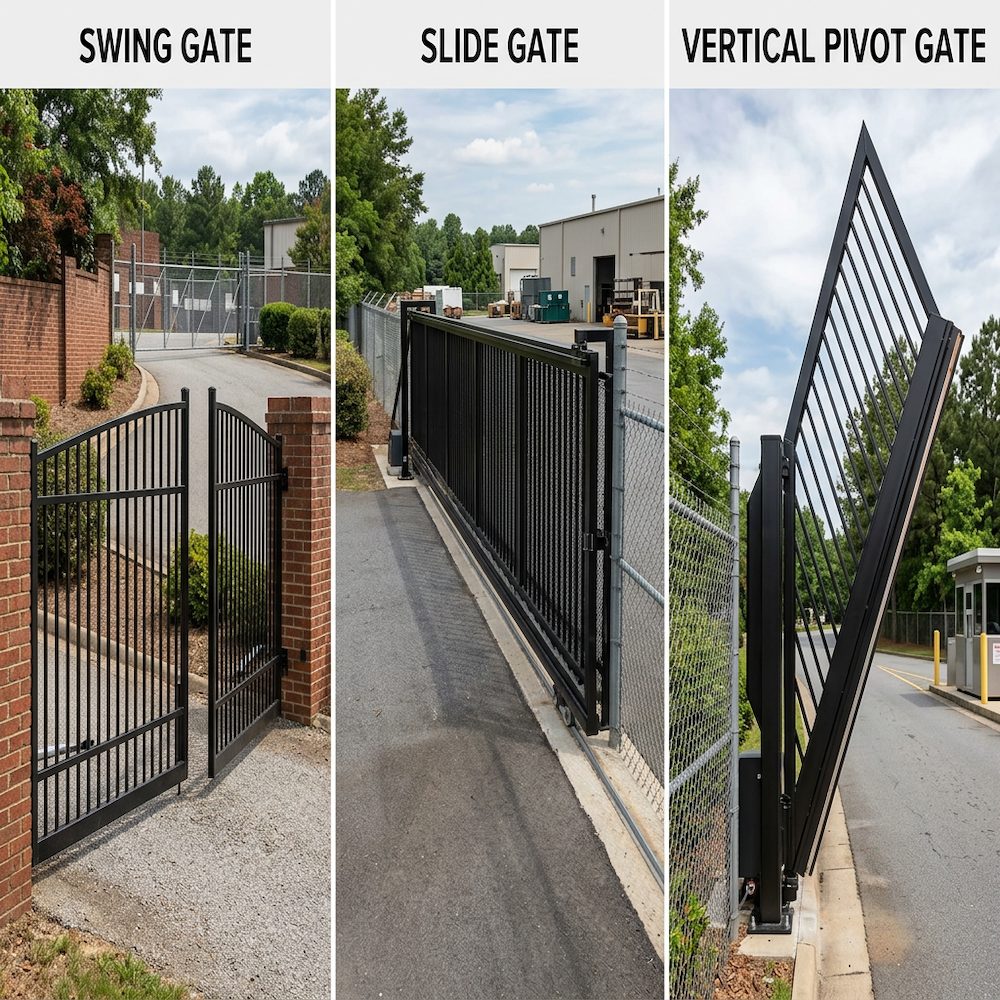
The three basic types of gates are swing gates, slide gates, and vertical lift or vertical pivot gates. Each type moves differently and suits different real-world conditions based on driveway layout, available space, and how often the gate will be used. Understanding these differences matters because an automatic gate system involves more than just the moving panel.
The operator, safety devices, posts, and access controls all work together to determine how reliably and safely a gate performs over time, especially in the Las Vegas Valley where heat, dust, and wind put added stress on every component.
Why Gate Type Selection Causes Confusion
Many property owners and managers find themselves unsure which gate type actually fits their situation. One neighbor has a swing gate that seems to work fine. A business down the street uses a slide gate. A commercial property nearby has a compact vertical system that lifts straight up. Without understanding the tradeoffs, choosing feels like guesswork.
The worry often centers on reliability. Will the gate jam in the middle of summer when temperatures climb well above 100 degrees? Will dust and sand work their way into the tracks or hinges and cause problems? Will the system hold up under daily use at a busy driveway or multi-tenant entrance, or will it constantly need repairs?
There is also confusion about what an automatic gate system actually includes. Many people expect a simple, set-and-forget solution. When they discover that photo eyes need cleaning, hinges need lubrication, and operators experience wear, the surprise can feel frustrating. Understanding the basic gate types helps set expectations before installation, not after repeated service calls.
The reality is that gate type selection involves more than appearance. Slope, clearance, wind exposure, traffic volume, and component quality all influence how a gate behaves over months and years of real use in Southern Nevada conditions.
How Each Gate Type Moves and Operates
Swing gates open and close like a standard door. They pivot on hinges attached to posts and require a clear arc of space to move through. A single swing gate needs room on one side of the driveway, while a dual swing configuration splits the opening and requires clearance on both sides. When the driveway slopes upward toward the property, swing gates may drag on the ground or require specialized hinges and operators to handle the grade.
Slide gates move sideways along a horizontal path. Track-based slide gates run on wheels that roll along a ground-mounted rail. Cantilever slide gates suspend the gate panel above the ground and use rollers mounted on a support structure, eliminating direct contact with a ground track. Both styles need a clear lateral path beside the driveway opening, typically at least as long as the gate panel itself. Slide gates handle sloped driveways more easily than swing gates because the motion stays horizontal rather than arcing through changing elevations.

Vertical lift and vertical pivot gates move upward instead of swinging or sliding. Vertical lift gates rise straight up, while vertical pivot gates hinge at a point and rotate upward. These systems work well where there is limited room to swing or slide a gate, such as tight commercial lots or properties with walls or landscaping close to the driveway. The tradeoff is that vertical systems place concentrated mechanical loads on the support posts and operator components, and they typically require more overhead clearance.
An automatic gate system combines the physical gate structure with an operator, which is the motor and drive mechanism that moves the gate. Safety devices like photo eyes and sensing edges detect obstructions and signal the operator to stop or reverse. Access controls such as remotes, keypads, card readers, or vehicle sensors trigger the gate to open. Each of these elements can age differently and may require its own maintenance or eventual replacement.
What Affects Long-Term Reliability and Safety
Reliability depends heavily on how often a gate cycles each day. A residential gate that opens and closes a handful of times sees far less wear than a commercial or multi-tenant gate that cycles dozens or hundreds of times daily. Hinges, rollers, chains, tracks, and operator internals all experience wear proportional to use. In Las Vegas, the combination of high cycle counts and extreme heat accelerates this process.
Heat and direct sun dry out lubricants, harden plastics and rubber components, and stress electronics and wiring insulation. Dust and sand work their way into tracks, roller assemblies, chain guides, and operator housings. Wind puts additional load on large gate panels, especially solid privacy-style designs that catch more air. None of these conditions stop automatic gates from working, but they make proper installation, component selection, and ongoing maintenance more important for predictable function over time.
Safety is an active system, not a passive feature. Photo eyes need a clear line of sight and clean lenses to detect vehicles, people, or objects in the gate path. Sensing edges and obstruction detection features must function correctly to reduce the risk of impact or entrapment. In dusty, windy conditions, lenses and sensors can become dirty or misaligned, reducing their effectiveness. Multi-tenant and commercial settings with more traffic see these issues develop faster.
Long-term cost relates more to lifecycle performance than purchase price alone. A gate type that seems simpler upfront can generate repeated service visits if poorly matched to the slope, wind exposure, or traffic patterns of the property. A more robust configuration may cost more initially but experience fewer breakdowns under heavy use. Electrical supply quality, conduit integrity, and protection from water intrusion during rare storms also affect how electronics and operators hold up over years of operation.
Common Misunderstandings About Automatic Gates
A frequent misconception is that all automatic gates are functionally the same and that the main difference is appearance. In practice, swing, slide, and vertical gates behave very differently in tight spaces, on slopes, under wind load, and in high-cycle commercial use. Assuming any gate type will work on any driveway can lead to clearance problems, binding, or uneven wear that was not anticipated.
Another common belief is that automatic gates require little attention beyond occasional battery changes in remotes. The reality is that mechanical joints, moving hardware, sensors, and electronic components all need periodic inspection and adjustment. In harsh desert environments, these needs arise more frequently as heat and dust speed up wear and misalignment.
Some property owners assume that adding an operator to an existing manual gate is always straightforward. A gate that was never designed for automation may lack the structural rigidity, proper post anchoring, hinge alignment, or clear swing or slide path needed for reliable powered operation. When this mismatch exists, customers often experience noise, strain, inconsistent movement, or repeated service issues that would not occur with a properly matched system.
There is also confusion between the gate itself and the broader access system. The physical gate, operator, safety sensors, keypads, remotes, and intercoms are separate components that can age at different rates, fail independently, and require different types of maintenance or upgrades. Understanding this distinction helps set realistic expectations about what may need attention over time.
How These Issues Appear in Everyday Use
In typical residential scenarios, a swing gate may begin dragging on uneven ground as soil shifts or concrete settles. A slide gate track can collect gravel, sand, and debris, causing jerky movement or complete stoppage. Photo eyes can go out of alignment from minor impacts or simply from expansion and contraction in temperature swings, causing the gate to reverse unexpectedly or refuse to close.
Commercial and multi-tenant settings experience these issues on a compressed timeline. High cycle counts wear hinges, rollers, chains, and operators faster. Without consistent inspection, small problems escalate into larger failures. A gate that worked reliably for months may suddenly stop closing properly because a sensor lens is coated in dust or a chain has stretched enough to affect timing.
Users often notice problems through gradual changes before full failure occurs. The gate moves a bit slower. There is a new noise during opening or closing. The gap at the closed position is slightly wider than before. Recognizing these early signs and addressing them through inspection and adjustment prevents more disruptive breakdowns.
Questions about the three basic gate types typically arise when property owners or managers are planning a new installation, considering an upgrade, or troubleshooting an existing system. Experienced professionals work with swing, slide, and vertical configurations daily in conditions like those found across the Las Vegas Valley, and that field experience informs realistic recommendations.
Setting Realistic Expectations for Your Property
Understanding the basic differences between swing, slide, and vertical gate types helps set realistic expectations about how each will behave under real-world conditions. The right choice depends on driveway layout, space constraints, traffic patterns, and environmental factors specific to the property.
Automatic gates are systems made up of multiple components. Long-term reliability, safety, and convenience depend on how those parts interact over time in a desert environment. Proper installation, appropriate component selection, and consistent maintenance all contribute to predictable performance.
The more useful question shifts from asking which gate looks best to asking how a specific gate type will actually perform day after day on a particular property and driveway. DNG Automatic Gates has served the Las Vegas Valley for more than 12 years, and owner Dave Williams brings over 25 years of hands-on industry experience to every evaluation.
If you are considering installation, repair, or an upgrade, you are welcome to request a consultation to discuss your specific situation. Visit the DNG Gates Contact Page or call (702) 505-3107 for a free estimate or to ask questions about what might work best for your property.


