

When an automatic gate stops responding or behaves erratically, the motor is often the first thing property owners suspect. In practice, most gate motor problems show up as a combination of power interruptions, mechanical resistance in the gate itself, safety sensors halting movement, or wear caused by heat, dust, and wind exposure.
Understanding how these factors work together in real-world conditions across Las Vegas, Henderson, and the surrounding valley helps set realistic expectations about what is actually going wrong and where to look first.
An automatic gate motor is only one component in a larger system that includes hinges, tracks, rollers, control boards, safety devices, and power supply. When the gate fails to open or close, the visible symptom may look like motor failure, but the underlying cause often lies elsewhere in that system. Recognizing this broader picture is the first step toward understanding why your gate behaves the way it does.
Why Gate Motor Problems Rarely Start With the Motor Alone
You press your remote or enter a code and the gate does not move. Sometimes it starts to open and then stops halfway for no clear reason. Other times it works fine in the morning but struggles, groans, or refuses to budge in the afternoon heat. When this pattern continues, especially during a windy day or late at night, it creates real frustration about whether your automatic gate can be counted on.
What most property owners experience as a motor problem is often the motor reacting to conditions elsewhere in the system. The motor has to push or pull a gate that may be heavy, out of alignment, or running on worn hinges, rollers, or tracks. It responds to signals from remotes, keypads, and safety sensors while depending on a stable electrical supply. When any of these elements are compromised, the motor may strain, stop mid-cycle, or refuse to engage entirely.
In the Las Vegas Valley, where temperatures routinely exceed 110 degrees in summer and dust storms are common, these stresses show up more frequently than in milder climates.
Electronics can be affected by prolonged heat. Dust settles on safety sensors and moving parts. Wind gusts push against wide swing gates or large sliding panels, forcing the motor to work harder or triggering safety reversals. None of these conditions necessarily break a motor immediately, but they accelerate wear and expose weak points in installation, alignment, or component sealing.

For property owners, the practical takeaway is that a gate stopping, reversing, or moving roughly does not automatically mean the motor has failed. It may mean the motor is responding appropriately to friction, obstruction, or sensor input somewhere else in the system.
How Gate Motor Problems Actually Appear in Daily Use
In everyday operation, gate motor problems tend to show up in predictable ways. The gate stops halfway through its travel. It reverses unexpectedly when nothing visible is blocking it. It moves slower than it used to or makes grinding, straining sounds that were not there before. Sometimes the gate responds from one remote but not another, or from the keypad but not from inside controls.
Each of these symptoms points to a different potential source. A gate that stops or reverses mid-cycle may be responding to safety sensors that detect an obstruction, even if that obstruction is just dust on a photo eye or a gust of wind pushing the gate off its expected path. A gate that moves slowly or makes unusual noise may be fighting against a misaligned track, worn rollers, or a sagging hinge that has increased mechanical resistance over time.
Power-related issues are also common. Automatic gates depend on stable electrical supply and, in some installations, backup batteries. A tripped breaker, loose power connection, failed transformer, or dead backup battery can all present as a non-moving gate. To the property owner, it simply looks like the motor has stopped working, even though the motor itself may be undamaged.
In commercial or multi-tenant settings where gates cycle many times per day, these issues can appear more frequently or become harder to track. Multiple users interacting with the gate may report inconsistent symptoms. The gate may seem to choose when it wants to work, creating concern about whether vehicles can get in and out during peak times or after hours.
Over time, owners may notice patterns. The gate struggles more during hotter parts of the day. It hesitates after dust storms. It reverses more often when wind is strong. These patterns often connect directly to how the motor and the surrounding gate system cope with real-world conditions in Southern Nevada.
What Property Owners Often Get Wrong About Gate Motors
Many people assume that if the gate does not move, the motor must have failed. This is a reasonable assumption on the surface, but it overlooks how often mechanical binding, sensor faults, or power interruptions cause the same visible result. A motor that receives no power cannot move the gate, but the motor itself may be perfectly functional once power is restored.
Another common misconception is that automatic gate motors are maintenance-free devices that will operate indefinitely without attention. In practice, they function as part of a moving mechanical system exposed to weather and dust. Periodic adjustment, lubrication of moving parts, and checking of safety devices and limits are often necessary for long-term reliability. When this ongoing need is not understood, owners can be surprised by noise, slower operation, or intermittent performance that shows up after years of otherwise trouble-free service.
There is also frequent confusion between the motor and the rest of the access control system. Problems with keypads, intercoms, or vehicle readers are often lumped together as motor issues, even though those components sit in separate parts of the system. If the intercom does not communicate with the gate controller, or if a keypad code is not being recognized, the motor may never receive the signal to engage. Describing these symptoms accurately matters when trying to narrow down what is actually happening.
For both residential and commercial properties, this confusion can make troubleshooting harder. When all gate-related problems are attributed to the motor, the actual source of trouble may go unaddressed, leading to repeat issues or unnecessary component replacement.
What Matters Most for Reliability, Safety, and Long-Term Costs
For most property owners, the core concerns are whether the gate will open and close reliably, whether it operates safely, and what the long-term costs look like. These concerns are directly connected to how the motor interacts with the rest of the gate system.
A motor that has to fight against a misaligned gate or run under constant heat stress may still move the gate, but it can become noisier, slower, and more prone to stopping mid-cycle. Mechanical components like hinges, rollers, tracks, and mounting posts all influence how hard the motor has to work and how long it lasts. When those surrounding parts are worn, misaligned, or dirty, the motor can appear underpowered or unreliable even if it is still within its expected service life.
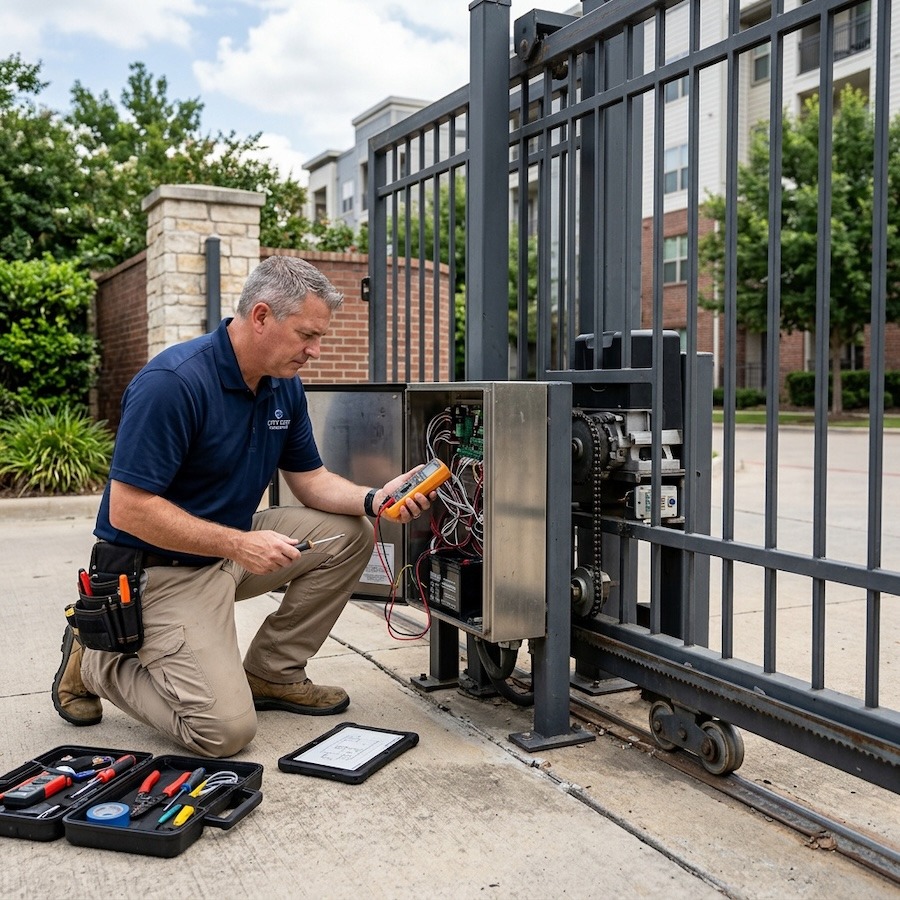
Safety matters whenever a heavy gate moves near vehicles and people. Modern gate motors often include built-in protections like obstacle detection, current sensing, and auto-stop logic. When these features engage, the gate stops or reverses, which can look like a malfunction to users who do not realize the system is responding appropriately to protect against injury or property damage. Sensitivity settings, partly influenced by the local environment and the gate’s mechanical condition, determine how often these protections activate.
From a cost perspective, ignoring contributing factors like worn hinges or misaligned tracks can lead to more frequent disruptions, shortened component lifespan, and higher overall costs over time. A motor that runs under excessive strain will wear faster than one operating within normal parameters. Addressing mechanical issues early often extends the useful life of the motor and reduces the total cost of ownership for the gate system.
When to Request a Professional Evaluation
When an automatic gate misbehaves, it helps to think of the motor as one part of a larger, moving system rather than as a single device that either works or fails. Symptoms like stopping, reversing, or intermittent operation often reflect how the whole gate system is coping with real-world conditions, not just whether the motor is good or bad.
Simple observations can help frame the issue. Whether the motor makes noise. Whether the gate tries to move at all. Whether only remote access is affected or all control points fail. Whether anything appears physically bent, off-track, or blocked. These details help narrow down whether the problem might be power-related, mechanical, sensor-related, or internal to the motor itself.
However, there is usually a limit to how much a non-technical property owner can safely verify, especially around powered components or heavy moving gates. Automatic gates involve real safety considerations, and working around them without proper knowledge can create risk.
If your automatic gate is behaving inconsistently, making unusual sounds, or failing to respond as expected, a professional evaluation can help identify whether the issue lies with the motor, the mechanical hardware, the power supply, or the safety and access control components that work alongside the motor.
For property owners in Las Vegas, Henderson, Pahrump, and the surrounding valley, feel free to visit the DNG Gates Contact Page or call (702) 505-3107 to discuss your specific situation or request a consultation.


