
Choosing the right security camera for a gate entry point requires understanding how these systems perform under real conditions. A camera positioned at a gate faces challenges that differ from standard surveillance setups, including constant motion, varying light, and exposure to weather.
For property owners in Las Vegas and the surrounding valley, selecting equipment that holds up in desert conditions while capturing usable footage matters more than feature lists alone. This article explains what actually works at gate entry points and why certain configurations outperform others in practice. For broader context on integrated surveillance options, visit our CCTV systems overview.
Camera Types That Perform at Gate Locations
Not every security camera handles the demands of a gate entry point equally. The position itself creates specific requirements that rule out many general-purpose options.
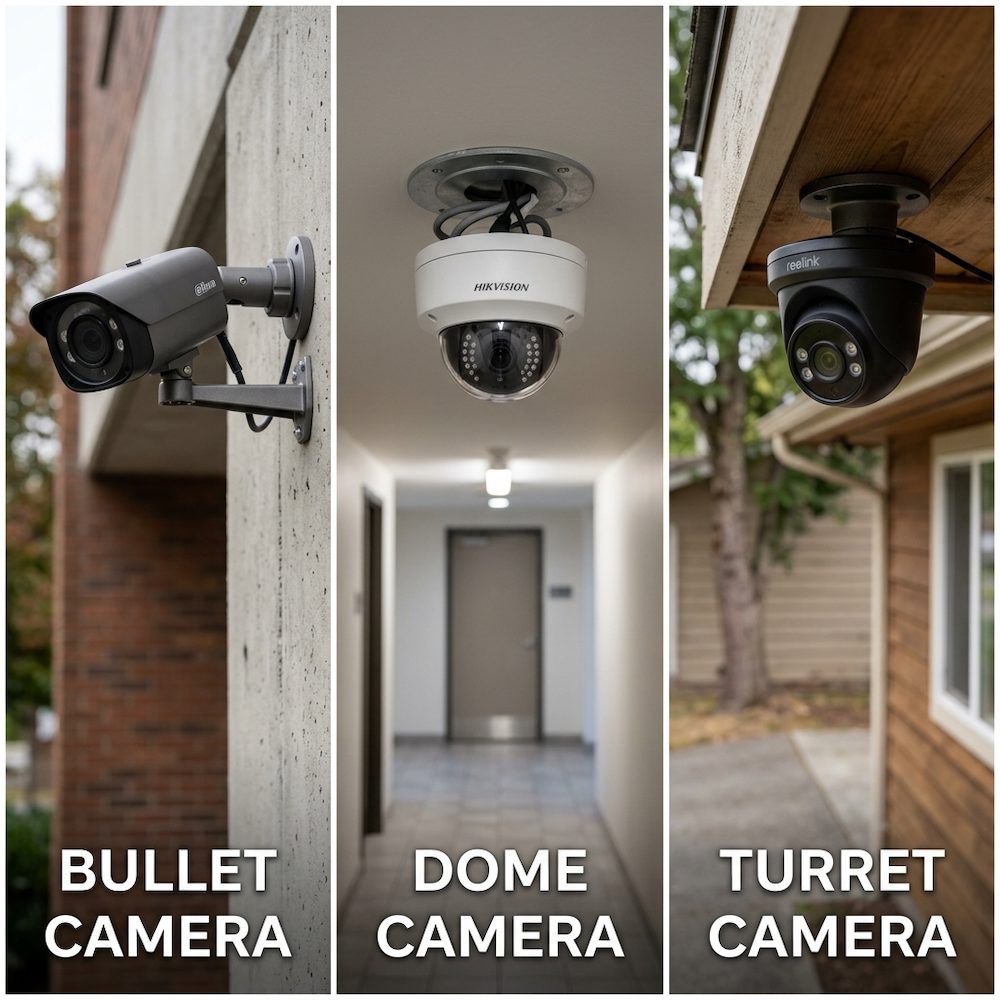
Bullet cameras remain a common choice for gate installations because of their focused field of view. They mount easily on posts or adjacent structures and aim directly at approaching vehicles or pedestrians. In practice, this narrow focus means the camera captures faces and license plates more reliably than wide-angle alternatives.
Dome cameras offer a different advantage. Their housing makes it difficult for someone to determine exactly where the lens points. This subtle deterrent effect can matter at entry points where visitors might otherwise attempt to avoid detection. However, dome housings can trap heat in extreme desert temperatures, which affects internal components over time.
Turret cameras have gained traction for gate use because they combine some benefits of both styles. The exposed lens allows heat to dissipate more effectively than a sealed dome, while the compact housing still obscures the exact viewing angle.
Pan-tilt-zoom models provide flexibility but introduce mechanical complexity. At a gate entry point, the camera often needs to capture a specific moment when a vehicle or person arrives. If the PTZ unit happens to be facing another direction during that moment, the footage becomes useless. For most gate applications, a fixed camera with proper placement outperforms a PTZ unit left in automatic patrol mode.
The best results come from matching the camera type to the specific layout of the gate and the primary purpose of the footage.
Resolution and Low-Light Performance in Desert Conditions
Camera specifications matter less than how those specifications translate to actual footage quality at the gate. Resolution and low-light capability are the two areas where real-world performance often diverges from marketing claims.
A camera rated at 4K resolution produces detailed images under ideal conditions. At a gate entry point in the Las Vegas Valley, ideal conditions rarely exist. Dust accumulation on the lens, heat shimmer from asphalt, and harsh midday sun all degrade image quality regardless of resolution. A well-positioned 2K camera with a clean lens often delivers more usable footage than a neglected 4K unit.
Low-light performance determines whether the camera captures anything meaningful after sunset. Many properties rely on gate cameras for overnight security, yet standard cameras struggle once ambient light drops. Infrared illumination helps, but the effective range varies widely between models. A camera rated for 100 feet of night vision may only produce clear images at 40 feet in practice, especially when dust particles scatter the infrared light.
True wide dynamic range capability matters at gates because vehicles approach with headlights on. Without proper WDR processing, headlights wash out the frame entirely, obscuring the driver and plate. Cameras designed for traffic monitoring handle this better than general surveillance models.
Desert heat also affects sensor performance directly. Image sensors generate noise at high temperatures, which reduces clarity. Cameras rated for extended temperature ranges hold up better through summer months when surface temperatures near gates can exceed 150 degrees.
Cleaning schedules and lens maintenance affect image quality as much as the camera itself. Dust buildup happens quickly in Southern Nevada, and a camera that performed well at installation may deliver unusable footage within weeks without regular attention.
Integration With Automatic Gate Systems
A security camera provides the most value when it works alongside the gate system rather than operating as a separate piece of equipment. Integration allows the camera to respond to gate activity and provide footage precisely when it matters.
Many modern gate operators include trigger outputs that activate when the gate receives an open command. Connecting this trigger to the camera system tells the recorder to mark that moment or switch to a higher frame rate. This makes reviewing footage far simpler because the relevant clips are already flagged.
Intercom systems with built-in cameras serve a dual purpose at entry points. They allow visual verification before granting access while also recording each visitor interaction. However, the image quality from intercom cameras typically falls below dedicated surveillance units.
Properties with higher security requirements often install both an intercom camera for live verification and a separate surveillance camera for recording.
Network-based systems allow footage to be accessed remotely, which matters for property managers overseeing multiple locations across the valley. A gate camera that feeds into a centralized monitoring setup provides more practical security than a standalone recorder that requires physical access to review.
Power considerations affect integration options. Gate locations do not always have convenient electrical access, and running new circuits adds cost. Power-over-Ethernet cameras simplify installation by carrying power and data through a single cable, reducing the infrastructure needed at the gate itself.
The physical environment at the gate also affects integration choices. Vibration from the gate mechanism can blur footage if the camera mounts too close to the operator. Positioning the camera on a separate post or structure avoids this problem.

Placement and Field of View Considerations
Where the camera mounts determines what it actually captures. A poorly placed high-end camera provides worse security than a properly positioned mid-range unit.
The primary goal at most gate entry points is capturing faces and license plates. These require different angles. Faces are best captured from near eye level, while plates are easier to read from a slightly elevated position angled downward. Properties with serious security concerns often install two cameras at the entry point, each optimized for one of these purposes.
Distance from the gate affects both image quality and the camera’s vulnerability to tampering. A camera mounted on the gate post itself captures close-range detail but can be blocked or damaged by someone standing at the entry. A setback position makes tampering more difficult and provides a wider view of the approach, though fine detail suffers.
Sun position creates problems that change throughout the day and across seasons. A camera facing west captures direct sunlight during afternoon hours for much of the year, which washes out images regardless of WDR capability. Evaluating the gate orientation and adjusting camera angles accordingly prevents predictable blind spots.
In the Las Vegas area, wind-driven dust and debris affect any equipment mounted outdoors. Cameras at gates face particular exposure because vehicles stir up additional dust as they approach. Housings rated for outdoor use help, but positioning the camera where it receives some shelter from prevailing winds extends service life and reduces cleaning frequency.
Field of view should capture the full approach zone without excessive wasted coverage. Ultra-wide lenses introduce distortion at the edges of the frame, which can make plate numbers unreadable even when they appear in the footage.
Maintenance and Long-Term Reliability
A security camera at a gate entry point only provides value if it continues working over time. The desert environment and constant exposure create maintenance demands that differ from indoor installations.
Lens cleaning needs to happen regularly. Dust accumulation is unavoidable, and even a thin film reduces image clarity significantly. Monthly cleaning is a reasonable baseline, with more frequent attention during windy periods or construction activity nearby.
Housing seals degrade in UV exposure and temperature extremes. Cameras rated for outdoor use include gaskets designed to prevent moisture and dust intrusion, but these materials break down over years of desert sun. Inspecting seals annually and replacing cameras before complete failure prevents gaps in coverage.
Cable connections at the gate are vulnerable to damage from gate movement, landscaping work, and rodent activity. Conduit protection and regular inspection of connection points reduces the risk of intermittent failures that may go unnoticed until footage is needed.

Firmware updates from manufacturers address security vulnerabilities and sometimes improve performance. Network-connected cameras require the same update attention as any other networked device. Outdated firmware can expose the camera to remote access by unauthorized parties.
Recording systems need their own maintenance. Hard drives in network video recorders have finite lifespans, and failures often happen without warning. Checking that recordings are actually being stored, not just that the camera shows a live image, catches problems before they matter.
Working With an Experienced Gate Installer
Selecting and installing security cameras at gate entry points involves considerations that extend beyond the camera itself. The electrical infrastructure, network connectivity, integration with access control, and positioning all affect whether the system performs as intended.
DNG Automatic Gates has served property owners across Las Vegas, Henderson, Pahrump, and the broader valley for more than 12 years. Owner Dave Williams brings over 25 years of hands-on experience with gate systems and the equipment that supports them. That field knowledge translates to practical recommendations based on what actually works at gate installations in Southern Nevada conditions.
If you are evaluating camera options for a new gate installation or considering upgrades to an existing entry point, a consultation can clarify which approach fits your property and priorities. Visit the DNG Gates contact page or call (702) 505-3107 to discuss your specific situation and request a free estimate.


