
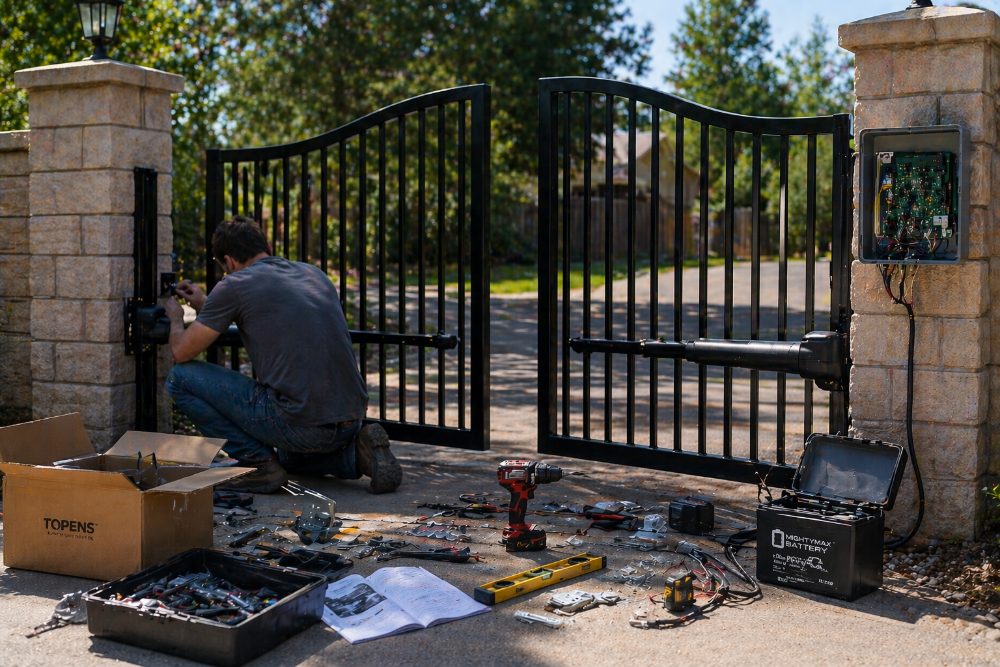
No, you cannot reliably install an automatic gate yourself and expect it to perform safely over time. What looks straightforward in a kit becomes far more demanding once you factor in the precise alignment of tracks, the calibration of safety sensors, and the mechanical strain that Las Vegas conditions place on every moving part. Automatic gate systems involve integrated electrical and mechanical components that require hands-on expertise to function correctly under real-world use.
The desert environment in Southern Nevada adds layers of difficulty that most homeowners do not anticipate. Heat expansion warps metal, fine dust grinds into moving parts, and wind forces stress panels and sensors in ways that demand experienced adjustment. Without the right tools and field knowledge, a self-installed gate often fails within months or creates safety hazards from the start.
What an Automatic Gate System Actually Involves
An automatic gate is not a single product. It is a coordinated system of components that must work together under mechanical load and environmental stress.

The main parts include the gate panel itself, a motor operator that powers movement, a control board that manages timing and commands, safety photo eyes that detect obstacles, edge sensors that trigger reversal on contact, and either tracks or hinges depending on whether the gate slides or swings. Power supply, wiring, and mounting hardware complete the setup.
Each of these elements depends on the others. If the track is even slightly misaligned, the motor strains. If the photo eyes sit at the wrong height or angle, they fail to detect obstructions. If the control board is not calibrated for the weight and travel distance of the gate, the system hesitates, overshoots, or stops mid-cycle.
In Las Vegas, the challenge deepens. Fine desert dust mixes with lubricants to form an abrasive paste that grinds down rollers, hinges, and tracks. Metal expands in extreme heat, causing binding at points that moved freely in cooler conditions. Low humidity generates static discharge that interferes with remotes and damages circuit boards.
These are not edge cases. They are the daily conditions any gate system faces in this region.
Why DIY Installation Falls Short in Desert Conditions
Homeowners often discover automatic gate kits online and assume installation is within reach. The kits include parts. The instructions list steps. The idea of saving money appeals.
What the kits do not include is the specialized knowledge needed to make the system last.
Proper installation requires torque adjustments matched to the gate’s weight and resistance. It requires level checks that account for slight ground shifts over time. It requires sensor placement that anticipates dust accumulation and sunlight interference. It requires electrical wiring that meets local code and protects against static buildup.
Without these adjustments, a gate may open and close for a few weeks, then begin sticking, grinding, or reversing without cause. In some cases, it stops detecting obstacles entirely, creating a serious safety risk.
Desert dust accelerates every form of wear. After a single wind event, rollers can clog with grit. Hinges stiffen. Sensors lose their calibration. A gate that seemed functional becomes unreliable almost overnight.
Heat adds another layer. Metal panels expand during the day and contract at night. Without precise clearances, the gate binds against its frame or drags along its track. The motor compensates by working harder, which shortens its lifespan.
These are conditions that demand field experience to manage. A kit cannot teach you what a gate sounds like when it is beginning to fail, or what adjustments prevent that failure in the first place.
Safety Standards and the Risk of Misalignment
Automatic gates carry real safety risks. A swinging gate can strike a person or vehicle. A sliding gate can trap limbs or pets. National standards like UL 325 exist specifically to prevent these outcomes.
Compliance requires dual entrapment protection. That means both sensors and force limits must function correctly. If a photo eye is blocked by dust or positioned incorrectly, it cannot detect an obstacle. If the motor’s force limit is not calibrated, the gate may not reverse when it should.
In a professional installation, these systems are tested under load. The installer verifies that the gate stops and reverses within safe parameters. They confirm that sensors respond to objects at the correct height and distance. They ensure that nothing in the setup creates a hazard during normal use.
A DIY approach rarely includes this level of testing. Most homeowners do not own the equipment or understand the thresholds. The result is a gate that appears to work but carries hidden risks.
In Las Vegas, wind and dust heighten these concerns. A sensor that functions in calm conditions may fail during a dust storm. A panel that clears its frame in the morning may bind by afternoon as temperatures rise. Without calibration that accounts for these variables, safety cannot be assured.
Real-World Failures and What They Reveal
In practice, self-installed gates tend to fail in predictable ways.
After wind events, residential gates often stick mid-cycle. Dust paste forms in the tracks and creates friction the motor cannot overcome. The gate halts, sometimes with a grinding noise, sometimes silently.

In high-traffic commercial settings, motors strain under repeated cycles during heat. The system slows, hesitates, or overheats. Boards fail from static discharge. Panels misalign as expansion shifts their position.
Maintenance visits reveal recurring patterns. Rollers wear prematurely when dust is not cleaned regularly. Hinges seize when lubrication dries out or becomes contaminated. Electronics fail when connections corrode or static builds unchecked.
These are not failures of the equipment itself. They are failures of installation and maintenance practices that did not account for local conditions.
A gate installed by someone with years of hands-on experience in the Las Vegas Valley is set up differently from the start. Clearances are wider. Lubricants are chosen for dust resistance. Electronics are sealed or positioned to reduce exposure. Sensors are angled to minimize false triggers from sunlight and debris.
These adjustments come from field knowledge, not from instruction manuals.
How Professional Practices Differ
Questions about self-installation often arise when homeowners or property managers begin planning access control. The appeal of saving on labor is understandable. But the comparison between DIY and professional installation is not simply about convenience.
It is about whether the gate will function reliably under the conditions it will actually face.
Professional standards emphasize concrete foundations that resist soil movement from heat cycles. They require wiring routed to code and protected from environmental exposure. They demand integration between the gate operator, safety sensors, and access controls like keypads or remote systems.
In a region like Southern Nevada, where conditions stress every component, these standards are not optional. They are the baseline for a system that works.
DNG Automatic Gates has served the Las Vegas Valley for more than 12 years. Owner Dave Williams brings over 25 years of hands-on industry experience. That depth of knowledge shapes every installation, from the choice of hardware to the calibration of sensors to the maintenance schedule that follows.
Reliability in this climate is not a matter of buying the right kit. It is a matter of applying experience to every decision.
What to Expect from an Automatic Gate Over Time
Automatic gates are long-term investments. Their value depends on consistent performance over years, not just the first few weeks after installation.
In residential settings, gates see intermittent use but still accumulate wear from dust, heat, and wind. Monthly cleaning of sensors and tracks extends function. Annual professional checks catch alignment issues before they cause damage.
Commercial gates endure far more cycles. Motors must handle repeated operation under load, often during the hottest parts of the day. Heavier-duty operators and more frequent service intervals are standard.
In both cases, the difference between a system that lasts and one that fails early comes down to how it was installed and how it is maintained.
Expectations should be realistic. An automatic gate is not a passive structure. It is a mechanical-electrical system that responds to its environment. In Southern Nevada, that environment is demanding.
The right approach treats installation as the beginning of a relationship with the system, not the end.
Considering a Gate Installation or Evaluation
If you’re considering installing an automatic gate yourself, it’s worth understanding what’s actually involved before committing to the project. What seems manageable at first can quickly become complicated once alignment, safety systems, and Nevada’s harsh climate come into play—often leading to costly fixes later.
A conversation with an experienced installer can help you make a more informed decision. Site-specific factors like wind exposure, driveway slope, and daily usage all play a role in how well a system performs over time—and whether a DIY approach is truly practical.
DNG Automatic Gates provides consultations for property owners in Las Vegas, Henderson, Pahrump, and the surrounding valley who are exploring installation, repairs, or upgrades. You can speak directly with a knowledgeable local team to better understand your options, expected maintenance, and what long-term reliability really looks like.
Thinking about doing it yourself? Get a second opinion first. Call 702-747-5101 or visit DNGGates.com/contact to discuss your project—no pressure, just straightforward guidance.


